Network advertising is full of awards, and each test behind them measures something different. For a business, the useful question is narrower: which network works best where your people actually work? This guide brings together the newest independent data from Ofcom, RootMetrics and Opensignal, explains what each measure tells you, and covers the 2026 changes that matter to buyers, from the VodafoneThree merger to the 2G switch-offs.
Not sure which network fits?
Get a free, no-obligation quote on EE, O2, Vodafone or Three for your business.
The short answer
On the 2026 data, EE leads most independent performance measures. It has the highest overall score in Ofcom's Mobile Matters 2026 report (85%), the top RootMetrics score for the first half of 2026 (95.6, its 26th consecutive UK award) and 11 outright wins in Opensignal's January 2026 report.
Coverage is a different story. The gaps are smaller and the leader changes with the measure: in Ofcom's January 2026 data Vodafone has the highest predicted 4G indoor coverage of premises, Three the widest 4G landmass coverage and EE the widest 5G coverage outside premises, while O2 won Opensignal's Coverage Experience award.
So there is no single winner. EE is the strongest all-round performer on these tests, but the best network for you is the one that works at your sites, on your routes and inside your buildings.
Who runs the UK's mobile networks now
Since the Vodafone and Three merger, the UK has three mobile network operators (MNOs), the companies that run the masts and hold the spectrum:
- EE, owned by BT Group.
- VodafoneThree, formed when Vodafone UK and Three UK merged on 31 May 2025. Vodafone took full ownership on 30 July 2026. The networks are being combined: VodafoneThree says that after a May 2026 upgrade across more than 10,000 sites, up to 28.6 million Vodafone and Three customers connect automatically to the best available coverage, and a new 5G core went live in September 2026. Ofcom still reports the two separately because their networks "are not yet fully combined", so this guide does too.
- Virgin Media O2, whose business arm rebranded from O2 Daisy to O2 Business in April 2026.
Everyone else is a mobile virtual network operator (MVNO) or reseller using one of these networks. Ofcom lists, for example, Tesco Mobile and giffgaff on O2, iD Mobile and Smarty on Three, Lebara and VOXI on Vodafone, and BT Mobile and Plusnet on EE; Gamma's business mobile uses Three. When you compare an MVNO or reseller, the coverage question is really about its host network.
Coverage: what Ofcom's data shows
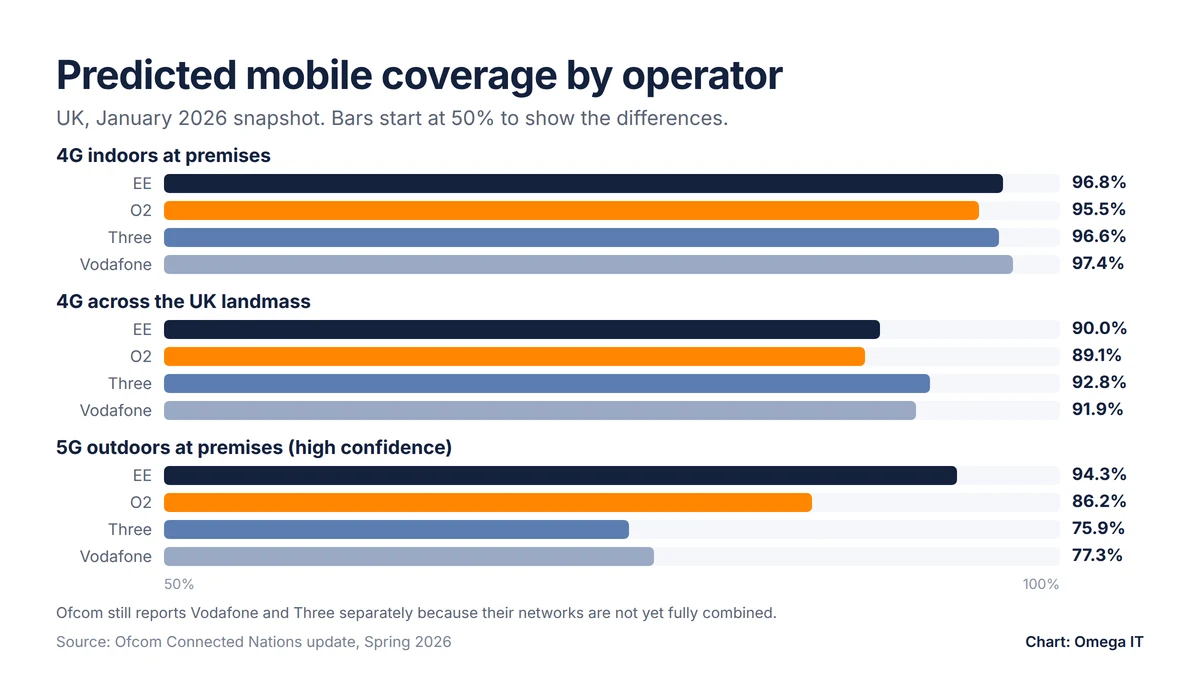
Ofcom's Connected Nations update for Spring 2026, published on 13 May 2026, uses a January 2026 snapshot and is the newest per-operator dataset. It is a prediction of where a signal of a given strength should be available, based on data the operators submit, rather than a measurement from people's phones.
| Predicted coverage, January 2026 | EE | O2 | Three | Vodafone |
|---|---|---|---|---|
| 4G, indoors at premises | 96.8% | 95.5% | 96.6% | 97.4% |
| 4G, outdoors at premises | 99.7% | 99.6% | 99.8% | 99.8% |
| 4G, UK landmass | 90.0% | 89.1% | 92.8% | 91.9% |
| 5G, outdoors at premises (high confidence) | 94.3% | 86.2% | 75.9% | 77.3% |
Outdoors, 4G is near-universal on every network. Indoors is where networks differ: each reaches between 95.5% and 97.4% of premises, but only 90.7% are predicted to get indoor 4G from all four, against 99.7% from at least one. So nearly one premises in ten has at least one network that is not predicted to work well indoors (our calculation). On 5G outside premises, EE leads by a wide margin.
Ofcom's methodology counts 4G coverage where it predicts at least a 98% chance of completing a 90-second voice call and at least a 95% chance of a 2 Mbit/s download. Its "high confidence" level means at least an 80% probability that coverage is present, and "very high confidence" around 95%. Operators' own claims, such as the share of the population covered, use different measures and dates, so do not compare them directly with Ofcom's predictions.
Coverage where your team works
Tell us your sites and usage and we'll quote plans on the network that suits.
Performance: what the independent tests say
Coverage tells you whether there is a signal; performance tells you what it is like to use.
Ofcom Mobile Matters 2026
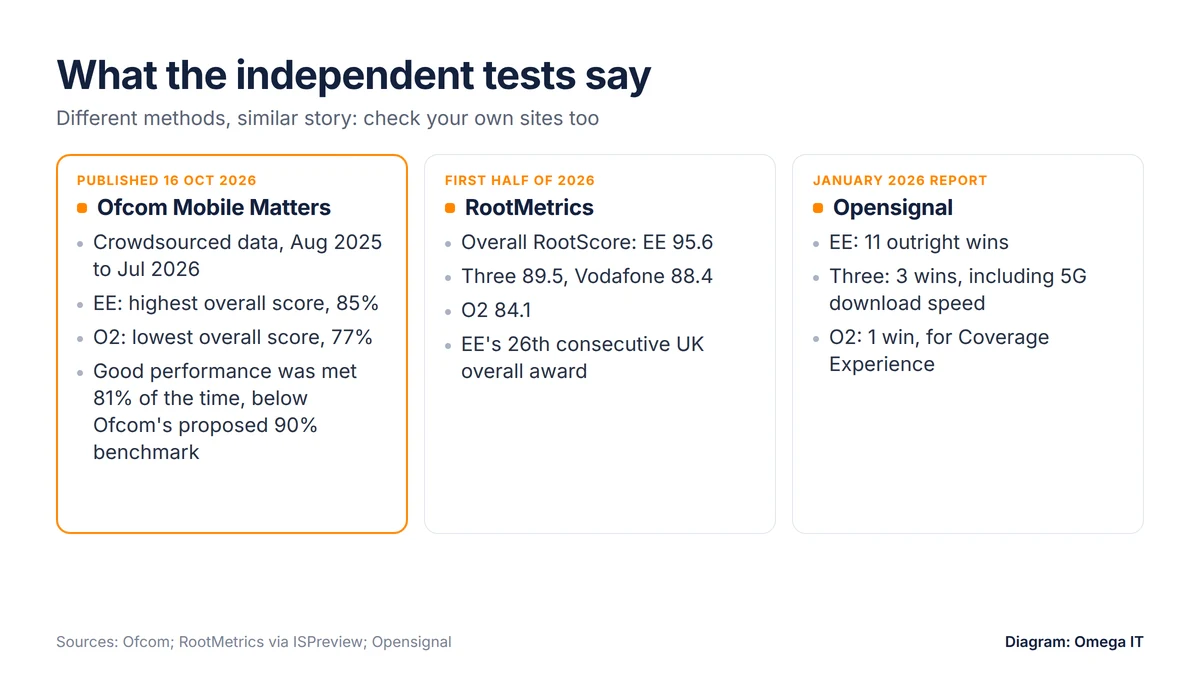
Published on 16 October 2026, Ofcom's report uses Opensignal's crowdsourced data from August 2025 to July 2026. It counts a connection as good when it delivers at least 5 Mbit/s download, 1.5 Mbit/s upload and one-way latency of no more than 50 milliseconds. EE had the highest overall score at 85% and the highest in every nation except Northern Ireland, where Vodafone came top; O2 had the lowest UK score at 77%. Across all networks, good performance was achieved 81% of the time, below Ofcom's proposed benchmark of 90%. 5G scored 92%, against 78% for 4G.
RootMetrics, first half of 2026
RootMetrics runs controlled tests: 609,278 of them between January and June 2026, across 16 metro areas, 722 indoor locations and 21,798 miles of driving. Its overall scores, as reported by ISPreview, were EE 95.6, Three 89.5, Vodafone 88.4 and O2 84.1. EE also had the fastest median download speed at 130.3 Mbps, against 54.7 Mbps for O2, 54.0 Mbps for Vodafone and 48.1 Mbps for Three.
Opensignal, January 2026
Opensignal's latest UK report, based on data from October to December 2025, gave EE 11 outright wins, including reliability, consistent quality and download speed. Three won three, including the fastest 5G download speed at 187 Mbps and time on network. O2 won one: Coverage Experience, where it scored 9.0 against EE's 8.8.
Use these results to build a shortlist, not to make the final decision.
5G and 5G Standalone
5G is now widespread outdoors, as the coverage table shows. RootMetrics measured 5G availability of 80% on EE and 78.0% on O2, against 62.3% on Vodafone and 62.6% on Three.
5G Standalone (SA) pairs 5G radio with a 5G core network and makes network slicing possible, where an operator sets aside capacity for particular customers or uses. EE launched Fast Lane, which it calls the UK's first commercial network slice, in August 2026; VodafoneThree says its Vodafone SuperMobile service offers a minimum download speed of 15 Mbps in 5G SA coverage. SA coverage is harder to compare:
- Ofcom's January 2026 data puts high-confidence 5G SA coverage outside premises at 85.1% for O2, 72.8% for EE and 49.5% for Vodafone, with no figure for Three.
- O2 says its 5G SA network reaches 87% of the UK population, which it calls the largest footprint in the country (March 2026).
- EE says its 5G+ (Standalone) network covers over 80% of the population (October 2026), with an ambition of 99% by the end of March 2030.
- VodafoneThree targets 5G SA coverage for 99% of the population by 2030 and 99.96% by 2034.
These are different measures taken at different dates, so treat them as a direction of travel, not a league table. For most teams today, reliable 4G and 5G coverage matters more than SA.
Rural and indoor coverage
Rural coverage has improved through the Shared Rural Network (SRN) programme. The SRN says Ofcom's Spring 2026 data shows good 4G coverage across 84% of the UK's landmass from all four operators, up from 66% before the programme began, and more than 96% from at least one operator, up from 91%. For Scotland, the SRN reports over 70%, up from 41%.
Away from towns, the gaps widen. Three and Vodafone had the widest predicted 4G landmass coverage in January 2026, while EE and O2 had far wider 5G landmass coverage. Because Vodafone and Three customers now share coverage at many sites, the separate figures may understate what either SIM can reach. Our guide to business mobile devices for field staff covers handsets and data for rural workers.
Indoors, every network's predicted 4G coverage of premises is roughly two to four points below its outdoor figure. A network that is strong in the street can still be weak at a desk or in a basement, so an on-site test matters more than any national figure. If indoor signal is poor, ask whether Wi-Fi calling is supported on your plans and handsets.
Find the right plan
We'll match handsets, data and device management to your team.
The 3G and 2G switch-offs and your kit
3G has gone. Ofcom confirms that Vodafone, EE, Three and O2 have all completed their 3G switch-offs: Vodafone and EE in February 2024, Three on 27 November 2025 and O2 by early 2026.
2G is next. The government says the operators will switch off their 2G networks between 2029 and 2033:
- EE will begin switching off 2G from May 2029.
- O2 will start in summer 2029, and began withdrawing 2G access for inbound roaming from 1 October 2025.
- VodafoneThree will switch off Vodafone's 2G network during 2030. Three has no 2G network.
- The operators have said they do not intend to offer 2G or 3G past 2033 at the latest.
This matters more for equipment than phones. The voluntary 2G switch-off charter (updated 22 October 2026) flags telecare, lift alarms and fire alarms as kit that can depend on 2G, and its signatories, covering around 95% of mobile customers, commit to announcing switch-off dates at least three years ahead. In its Connected Nations 2025 report, Ofcom estimated around two million direct customer devices relied on 2G or 3G. Check anything on your premises with its own SIM, such as alarm diallers, lift lines, telecare units, vehicle trackers and card machines, and ask the supplier which network technology it uses. Much of the same kit is caught up in the analogue line switch-off too; see our PSTN switch-off guide.
How to test coverage at your sites
- Start with Ofcom's Map Your Mobile checker. Enter the postcode of every office, depot and regular customer site, and compare the networks.
- Test on the ground. Borrow SIMs or use a trial, and test calls and data inside each building, including meeting rooms, warehouses and basements, not just the car park.
- Use a spare eSIM slot. A dual-SIM phone can test a second network without swapping cards; our eSIM guide for business explains how eSIM works.
- Cover the routes. Ask field staff to note where calls drop on their usual journeys.
- Ask your team. Staff already know the dead spots and which networks they use personally.
- Remember predictions are probabilities. Even Ofcom's very high confidence level means around a 95% probability of coverage at a location, so expect some gaps no map shows.
Choosing a network for a mixed team
Most businesses need the right default network and a plan for the exceptions.
- Office-based staff: choose on indoor performance at your main sites. If every network serves your building well, the national performance results are a reasonable tiebreaker.
- Field and site staff: weight rural landmass coverage and test their routes. A different network for this group can be worth the extra admin.
- Frequent travellers: compare roaming terms, which vary by network and plan family.
Avoid signing a long contract because of a single award, and ask suppliers what happens if a site turns out to be poorly served. Our guide on how to choose a business mobile provider covers contracts, pooled data and support, and our best business mobile phones for 2026 helps match handsets to each group.
How Omega IT can help
Omega IT quotes business mobile on EE, O2, Vodafone and Three, with SIM-only and handset plans quoted against your business's real usage. It also offers business mobile and device management. Quotes are free and no-obligation: request a business mobile quote.
Sources
- Ofcom: Connected Nations update: Spring 2026 (13 May 2026)
- Ofcom: Connected Nations Spring 2026 mobile coverage data, January 2026
- Ofcom: Connected Nations 2025: UK report (19 November 2025)
- Ofcom: Connected Nations 2025 methodology annex
- Ofcom: Mobile Matters 2026 (16 October 2026)
- Ofcom: Map Your Mobile coverage checker
- Ofcom: 2G and 3G switch-off: our expectations of mobile providers (updated 29 May 2026)
- Ofcom: 3G switch-off (host networks of mobile brands)
- GOV.UK: Preparing for the 2G switch-off (updated 29 July 2026)
- GOV.UK: 2G switch-off charter (updated 22 October 2026)
- EE: RootMetrics H1 2026 UK substantiation (July 2026)
- ISPreview: RootMetrics awards EE as the best UK mobile operator in H1 2026 study (4 August 2026)
- Opensignal: UK Mobile Network Experience Report (January 2026)
- Vodafone: Completion of Vodafone and Three merger in the UK (31 May 2025)
- Vodafone: Vodafone takes full ownership of VodafoneThree (30 July 2026)
- VodafoneThree: World-first network upgrade (eMOCN) (26 May 2026)
- VodafoneThree: Ericsson rollout begins on new 5G core network (17 September 2026)
- O2 Business: O2 Daisy unveils new O2 Business brand (29 April 2026)
- Virgin Media O2: O2 doubles down on mobile network improvements in 2026 (2 March 2026)
- EE: EE's 5G+ network reaches more than 80% of the UK (October 2026)
- Shared Rural Network: Ofcom update highlights continued improvements in rural mobile coverage (14 May 2026)
- Gamma: Gamma Business Mobile
General guidance, accurate to October 2026. Diagrams by Omega IT.