Microsoft sells three main Microsoft 365 plans to small and medium-sized businesses: Business Basic, Business Standard and Business Premium. They share the same email, storage and Teams foundations and the same 300-user limit, but differ in two ways that matter: whether staff get the installable desktop Office apps, and how much security and device management is built in. Choose the wrong one and you either leave people without the tools they need or pay for features nobody uses.
This guide compares the three as they stand in October 2026, from Microsoft's UK pages and documentation. Prices are Microsoft's UK list prices, per user per month, excluding VAT, and indicative: what you pay depends on how and where you buy.
Not sure which plan fits?
Talk to Omega IT about matching Microsoft 365 Business plans to the way your team works.
The short answer
- Business Basic suits people who work in a browser or on a phone: business email, Teams, 1 TB of OneDrive and web and mobile Office apps.
- Business Standard adds desktop apps that work offline, plus Teams webinars. It suits office teams who spend the day in Excel, Word and Outlook.
- Business Premium adds security and device management: Intune, Entra ID P1 with Conditional Access, Defender for Business, Defender for Office 365 and Purview data protection. In our view it is the sensible default for businesses that hold customer data or want Cyber Essentials-style controls.
- More than 300 users? The Business plans stop there, so you need an Enterprise plan such as Microsoft 365 E3 or E5.
Moving from another email system? Licensing is one of the first steps in our Microsoft 365 migration guide.
What every Business plan includes
All three plans share the same core:
- Business email on Exchange, using your own domain (name@yourbusiness.com).
- A 100 GB mailbox per user, according to Microsoft's Exchange Online limits.
- 1 TB of OneDrive cloud storage per user.
- Microsoft Teams for chat, calls and online meetings of up to 300 people, on the versions sold with Teams.
- Ten or more extra apps, including Bookings, Planner and Forms.
- A 300-user limit. Microsoft's UK plan pages say the Business plans support "a maximum of 300 users".
The mailbox size is new. Microsoft's 2026 price and packaging update added "+50GB email" to all three plans, taking mailboxes from 50 GB to 100 GB, rolling out from June 2026. The notice gives no completion date for the mailbox change, so check what your tenant shows. The update also added URL time-of-click protection to Basic and Standard.
Every plan also starts with basic sign-in protection: Microsoft says security defaults, which turn on multi-factor authentication (MFA), are on by default for new tenants. On an older tenant, check MFA is actually enforced; our guide to MFA for small businesses explains why.
Business Basic
Business Basic is the entry plan. Microsoft describes its apps as "lightweight web and mobile versions" of Word, Excel, PowerPoint and Outlook, used online rather than installed. Everything else in the core set is included. Microsoft's UK list price is £5.40 per user per month, paid yearly (indicative).
Basic suits field, frontline or part-time staff who mainly need email, Teams and shared files. The trade-off is the apps: the web versions cope with everyday documents, but anyone who builds complex spreadsheets, works offline or relies on desktop Outlook will soon feel the limits. Basic also has a 50 GB archive mailbox and none of Premium's security tools.
Is Business Premium worth it for you?
Get advice on whether Premium's security tools suit your business and how to set them up.
Business Standard
Business Standard includes everything in Basic plus installable desktop versions of the Office apps, which Microsoft says "can be used offline". Each user can install them on up to five computers, five tablets and five phones. Teams gains webinar hosting, and the extra apps include Microsoft Loop and Clipchamp. Microsoft's UK list price is £10.80 per user per month, paid yearly (indicative).
What Standard doesn't add is security: no Intune, no Conditional Access, no Defender for Business, and a 50 GB archive. If you choose it, plan separately for managing laptops and phones and protecting them from malware. Microsoft sells Defender for Business as a standalone add-on at £2.30 per user per month (Microsoft's UK list price, indicative), and our Microsoft Intune guide covers device management.
Business Premium: the security plan
Business Premium includes everything in Standard and adds security and management tools. Microsoft's UK Premium page and documentation list:
- Microsoft Intune Plan 1, to "simplify device and app administration across platforms".
- Microsoft Entra ID P1, which includes Conditional Access. Microsoft describes Premium's sign-in controls as "policy-based identity and access management", compared with "core" identity and access management in Basic.
- Microsoft Defender for Business, device protection with vulnerability management, which Microsoft describes as equivalent to Defender for Endpoint Plan 1 with some Plan 2 features.
- Microsoft Defender for Office 365, to help protect against email phishing, ransomware and other threats.
- Microsoft Purview Data Loss Prevention and Information Protection, to help stop sensitive data being shared and to classify and label important documents.
- A 1.5 TB archive mailbox, as on E3 and E5, against 50 GB on Basic and Standard.
Microsoft's UK list price is £16.90 per user per month, paid yearly (indicative). Why do we see it as the right starting point for many small businesses?
- Cyber Essentials has tightened. Under version 3.3 of the requirements, in force since 27 April 2026, authentication to cloud services must always use MFA, and IASME says organisations that don't will automatically fail. Security defaults can switch MFA on, but Premium adds policy-based sign-in controls, device management and device protection that make the rest of an assessment easier to evidence (see our Cyber Essentials self-assessment guide).
- Email protection. Defender for Office 365 adds protection against the kind of phishing described in our guide to phishing and invoice fraud.
- The price gap has narrowed. Since the July 2026 rise in Standard's price, Premium costs £6.10 more per user per month at Microsoft's UK list prices, down from £7.30 (our calculation, indicative). For ten people, that's £61 a month for device management, device protection and Conditional Access.
Premium's tools only help once they're configured and reviewed. Whichever plan you choose, treat backup as a separate decision (our Microsoft 365 backup guide explains why), and for sign-ins beyond MFA, see our guide to password managers and passkeys.
Basic vs Standard vs Premium side by side
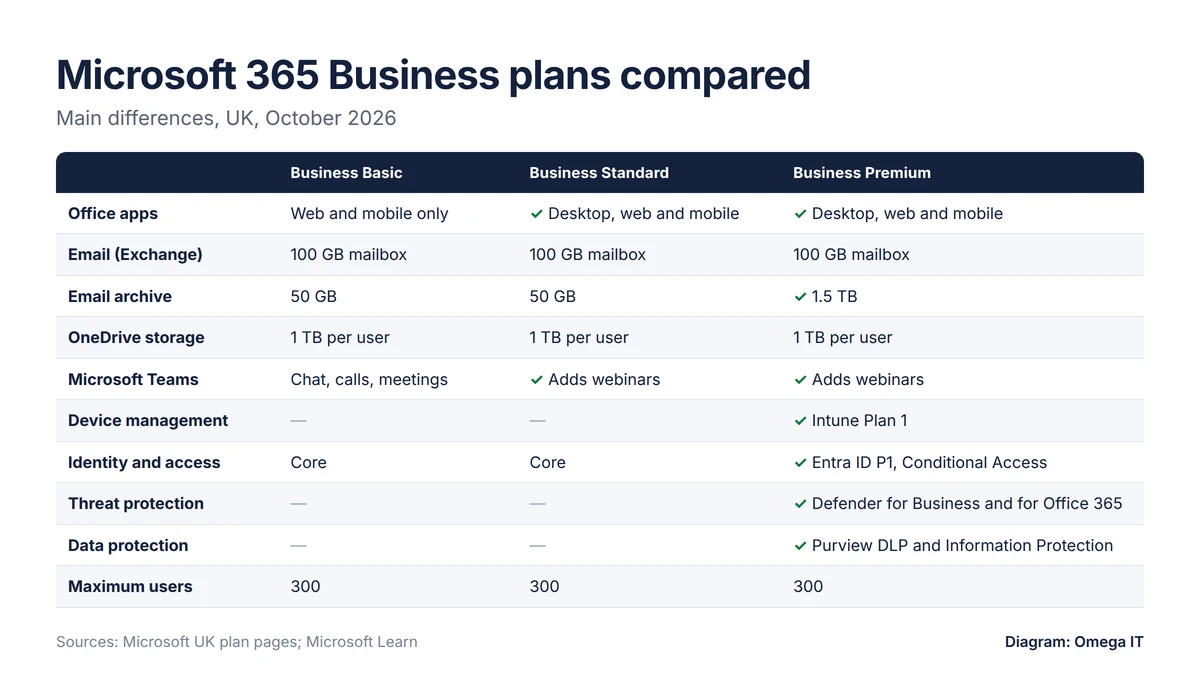
| Feature | Basic | Standard | Premium |
|---|---|---|---|
| Office apps | Web and mobile | Desktop, web and mobile | Desktop, web and mobile |
| Mailbox / archive | 100 GB / 50 GB | 100 GB / 50 GB | 100 GB / 1.5 TB |
| Teams | Meetings up to 300 | Meetings up to 300, plus webinars | Meetings up to 300, plus webinars |
| Device management | No | No | Intune Plan 1 |
| Conditional Access | No | No | Yes (Entra ID P1) |
| Defender for Business and Defender for Office 365 | No | No | Yes |
| Purview data protection | No | No | Yes |
Standard adds productivity; Premium adds protection. If you'd struggle to say which devices hold company data, or who can sign in from where, Premium deserves a serious look.
Want this set up for you?
Omega IT can configure and manage Microsoft 365 for your team.
UK prices in 2026
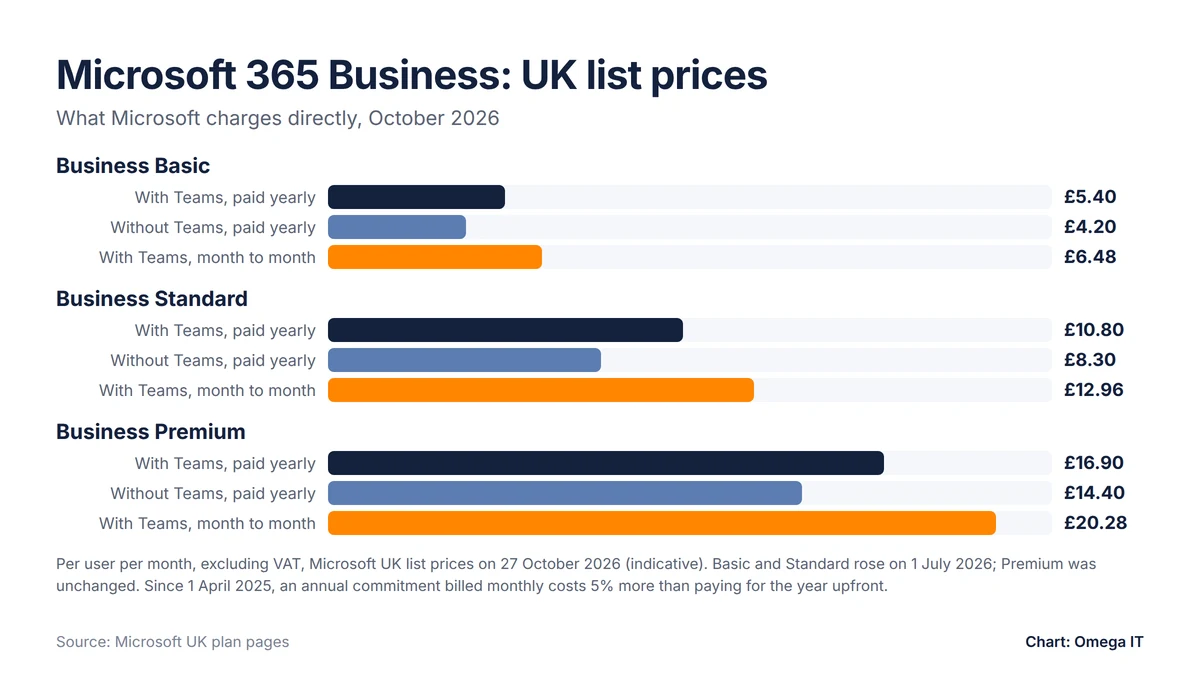
On an annual subscription paid yearly, Microsoft's UK list prices on 27 October 2026 are £5.40 for Business Basic, £10.80 for Business Standard and £16.90 for Business Premium, per user per month excluding VAT (indicative). Without Teams, they are £4.20, £8.30 and £14.40.
Paying monthly
Microsoft's UK pages also offer a month-to-month subscription at £6.48 for Basic, £12.96 for Standard and £20.28 for Premium (Microsoft's UK list prices, indicative). That is 20% more than paying yearly (our calculation).
A separate uplift has applied since 1 April 2025: Microsoft prices annual subscriptions billed monthly 5% higher than paying the year upfront. When comparing quotes, check whether each is month-to-month, annual billed monthly or annual paid upfront.
The 1 July 2026 price rise
Microsoft raised Basic and Standard prices on 1 July 2026 as part of a global update. In the UK, Basic with Teams went from £4.60 to £5.40 and Standard from £9.60 to £10.80, paid yearly (Microsoft's UK list prices, indicative; earlier prices from archived copies of Microsoft's UK pages). Premium stayed at £16.90. Microsoft says "existing customers remain on current pricing until renewal", so you may not see the change until your next renewal date.
Adding Copilot
Microsoft 365 Copilot Business is an add-on for existing customers on an eligible Business plan. Microsoft's UK Copilot page lists it from £13.80 per user per month paid yearly, down from £16.10, under a promotion to 31 December 2026 that needs an annual commitment and covers the first year only (Microsoft's UK list prices, indicative). Our Copilot guide for small businesses asks whether it's worth it.
With or without Teams
Since April 2024, Microsoft has sold its Business plans worldwide with and without Teams. The UK isn't in the European Economic Area, so it follows the worldwide rules, and Microsoft's UK pages show both versions of all three plans.
At Microsoft's UK list prices, dropping Teams saves £1.20 per user per month on Basic and £2.50 on Standard and Premium (our calculation, indicative). That makes sense if you already use another platform for chat and meetings and plan to stay with it. Bear in mind:
- Microsoft's 300-person meeting limit applies to subscriptions "that have a Microsoft Teams license".
- Teams Phone, Microsoft's cloud phone system, needs a Teams licence (see our guide to Teams Phone vs hosted VoIP).
- On 1 November 2025, Enterprise suites with Teams went back on sale to all customers. Some Microsoft Learn pages still say they aren't available, so check the date of anything you read.
Mixing plans, and when to look at E3 or E5
Microsoft prices these plans per user, and you don't have to give everyone the same one: office staff might have Standard or Premium, and people who only need email, Teams and files might have Basic. If you mix plans, remember an attacker only needs the weakest account, so ask how your sign-in and device policies will cover anyone without Premium.
Microsoft's Enterprise plans support organisations of any size. Its UK Enterprise page lists E3 at £33.50 and E5 at £51.60 per user per month with Teams, or £27.00 and £45.00 without, paid yearly on an annual commitment (Microsoft's UK list prices, indicative). Compared with the Business plans:
- E3 and E5 raise the meeting limit to 1,000 people and offer between 1 TB and 5+ TB of cloud storage per user.
- E5 includes the Teams Phone system and Audio Conferencing, plus Power BI for business analytics.
E3 costs nearly twice as much as Business Premium at list price (our calculation), so under 300 users it rarely makes sense for security alone, in our view. If Teams Phone draws you to E5, compare Business Premium plus a Teams Phone Standard licence at £7.70 per user per month (Microsoft's UK list price, indicative): less than half the cost of E5 at list prices (our calculation). Either way, you'd still need a calling plan or carrier for phone numbers.
How Omega IT can help
Omega IT offers Microsoft 365 services and cyber security services to UK businesses, and is Cyber Essentials Plus certified. If you're deciding between Basic, Standard and Premium, or want Premium's security tools set up properly, talk to our team. Quotes are free and no-obligation.
Sources
- Microsoft: Microsoft 365 Business Basic (UK) (accessed 27 October 2026)
- Microsoft: Microsoft 365 Business Standard (UK) (accessed 27 October 2026)
- Microsoft: Microsoft 365 Business Premium (UK) (accessed 27 October 2026)
- Microsoft: Compare all Microsoft 365 business products (UK) (accessed 27 October 2026)
- Microsoft: Microsoft 365 Enterprise plans and pricing (UK) (accessed 27 October 2026)
- Microsoft: Microsoft 365 Copilot Business (UK) (accessed 27 October 2026)
- Microsoft Learn: Microsoft 365 Business Premium security overview
- Microsoft Learn: Exchange Online limits
- Microsoft Learn: Microsoft Teams add-on licensing
- Microsoft Licensing: Microsoft 365 and Teams licensing update (3 November 2025)
- Microsoft Licensing: 2026 Microsoft 365 packaging and pricing updates (16 February 2026)
- Microsoft Learn: Partner Center announcements, March 2025
- Internet Archive: Microsoft 365 Business Basic UK page, archived (3 February 2026)
- Internet Archive: Microsoft 365 Business Standard UK page, archived (11 May 2026)
- NCSC: Cyber Essentials: Requirements for IT Infrastructure v3.3 (April 2026)
- IASME: Important update: changes to Cyber Essentials for April 2026 (12 February 2026)
General guidance, accurate to October 2026. Prices change; any prices shown are indicative. Diagrams by Omega IT.