
Connectivity is the one piece of IT that, when it fails, stops everything. Yet it is often bought on a single number, the headline download speed, when the things that actually determine whether your business stays productive and online are elsewhere. This UK buyer's guide explains the main options, what to check beyond the download figure, and how to build in the resilience a business needs.
Choosing business connectivity?
Get a free, no-obligation quote and get the right connection for your business.
The main options, in plain terms
Most UK businesses are choosing between a few types of connection:
- Full-fibre broadband (FTTP) — fibre all the way to your premises. Fast, increasingly available (helped by the government's Project Gigabit programme), and good value. It is shared and sold as an "up to" speed.
- SoGEA and part-fibre — broadband over a mix of fibre and copper, common where full fibre has not yet reached. A stepping stone as the old network is retired.
- Leased line — a dedicated connection just for you, with guaranteed symmetric speed and a repair SLA. The premium option for businesses that cannot afford downtime.
- Mobile (4G/5G) — increasingly viable as a primary connection in some locations, and widely used as a backup.
Full-fibre broadband vs a leased line
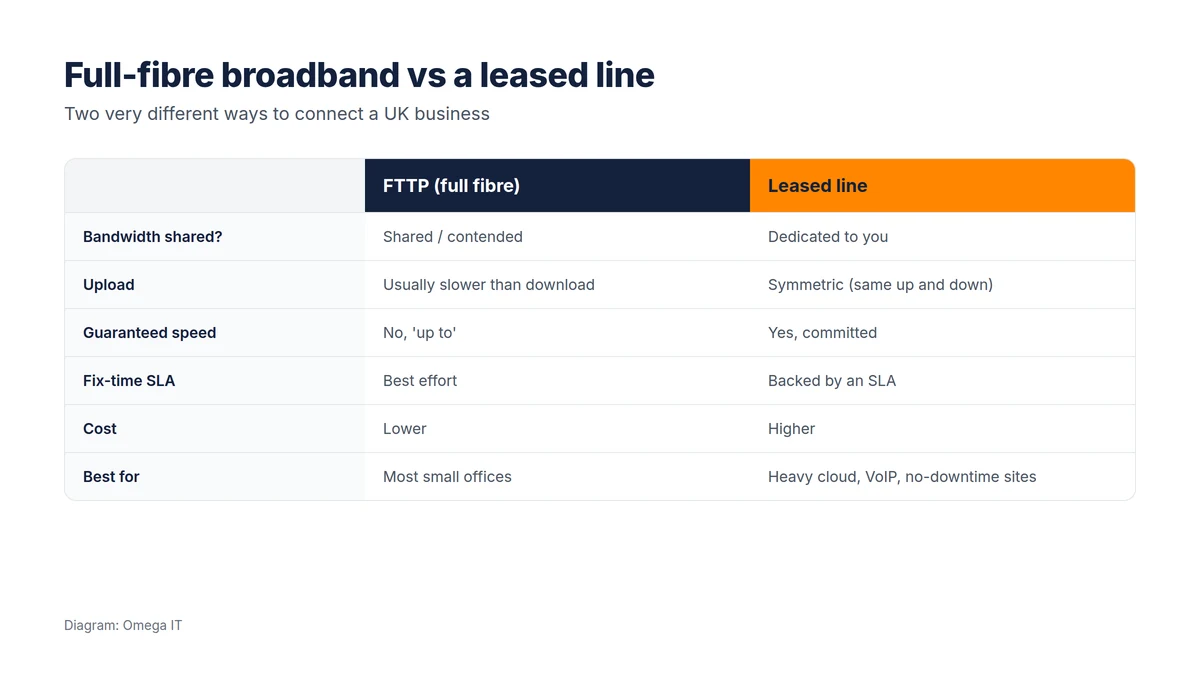
The core difference is dedication and guarantees. Full fibre is shared with other users and sold as a best-effort "up to" speed, with download faster than upload and repairs on a best-effort basis. A leased line is yours alone, with a committed speed that is the same up and down, and a contractual fix-time SLA. For most small offices, full fibre plus a backup connection is the sensible, cost-effective choice; a leased line earns its higher cost where downtime is unacceptable, upload is heavy (large file transfers, many simultaneous video calls or hosted phones), or an SLA-backed repair time is essential.
What to check beyond download speed
Upload speed and symmetry
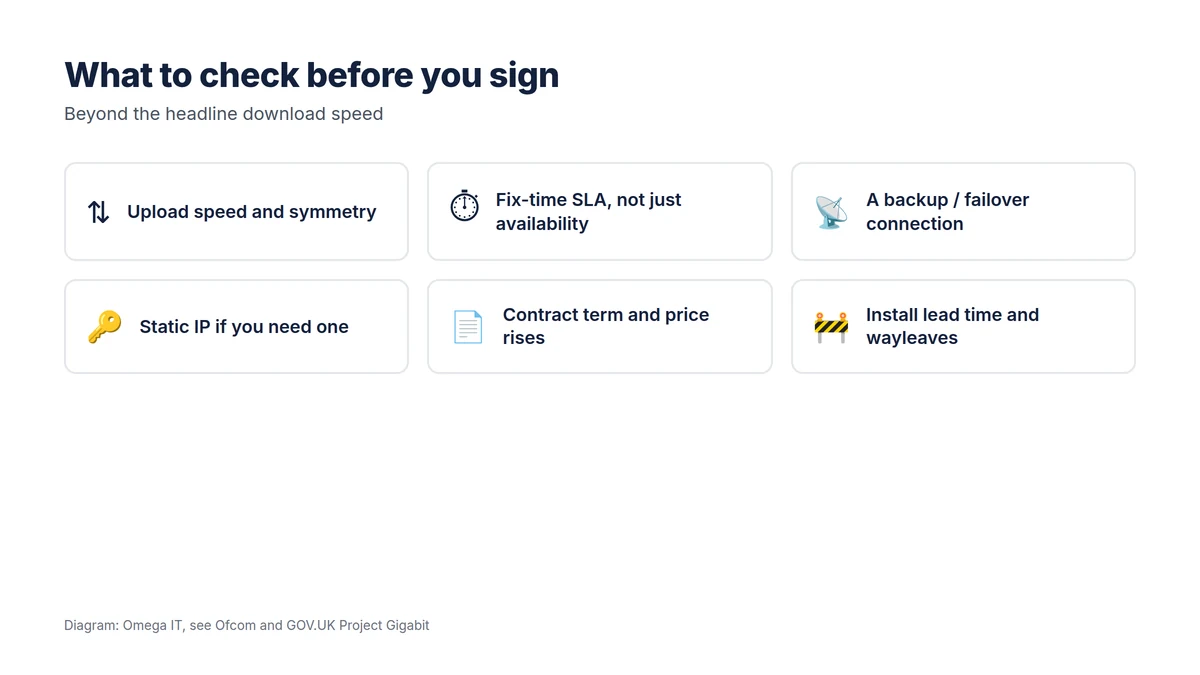
Modern work is upload-heavy: cloud backups, sending files to Microsoft 365, video calls and hosted phone systems all push data out. A connection with fast download but weak upload can still feel slow. Check the upload figure, not just the download, and run our speed test at busy times to see what you actually get.
A fix-time SLA, not just availability
Ask what happens when it breaks. Consumer-grade broadband offers best-effort repairs; a business connection should tell you how quickly a fault will be fixed. If connectivity is critical, that SLA is worth paying for.
Resilience and failover
If being offline stops you trading, one connection is one point of failure. A second line, ideally from a different provider or technology such as 4G/5G, keeps you running. Businesses with several sites can combine and fail over between connections automatically with SD-WAN.
The practical details
Confirm whether you need a static IP (for remote access, CCTV or a firewall), the contract term and any mid-term price rises, and the install lead time, which can stretch where new fibre or wayleave permissions are needed.
Look beyond download speed
Our UK team can help you pick and manage the right broadband or leased line.
Connectivity and the PSTN switch-off
Connectivity and telephony are now the same conversation. As the analogue phone network is withdrawn by January 2027, your voice service moves onto your internet connection, so a reliable, well-sized connection with a resilience plan matters more than ever. Our PSTN switch-off guide and our guide to moving business phones to hosted VoIP cover that transition, and voice is a good reason to care about upload and failover.
How to choose
- Work out what being offline would cost you; that sets how much resilience to buy.
- Size the connection by upload as well as download, based on cloud use, backups, video and voice.
- Decide whether a best-effort broadband repair is acceptable, or whether you need an SLA-backed leased line.
- Add a backup connection if downtime stops trading.
- Check the practical details: static IP, term, price rises and install lead time.
How to size your connection
Rather than guessing at a big number, size the connection around what your business actually does at once. A rough, practical method:
- Cloud and Microsoft 365: everyday work (email, documents, browsing) is light per person, but it adds up across a team and it leans on upload when saving and sharing.
- Video calls: allow a few megabits per simultaneous call, in both directions, and assume several people may be on calls at peak.
- Hosted phones (VoIP): each concurrent call needs only a small, steady amount of bandwidth, but it must be consistent, which is why upload quality matters more than raw speed.
- Backups and large transfers: off-site backups and big file uploads are upload-heavy and can saturate a weak connection, so schedule them or size for them.
The theme is that upload and consistency usually matter more for a modern business than a huge download headline. A connection that looks fast on a speed test can still feel slow if everyone is uploading and calling at once.
Want this handled for you?
Omega IT can take the day-to-day IT off your plate.
Resilience, in order of cost
How far you go on resilience should match what downtime costs you:
- Single connection. Fine for a business that can tolerate the occasional outage.
- Primary line plus 4G/5G failover. A modest step up: if the main line drops, a mobile connection keeps essentials running.
- Two diverse lines with automatic failover (SD-WAN). For businesses that cannot afford to be offline, two connections from different providers or technologies, combined so traffic moves automatically when one fails.
- Leased line with a backup. The top tier: a dedicated, SLA-backed line with its own failover, for sites where downtime is simply not an option.
Common mistakes to avoid
- Buying on the download figure alone and discovering the upload cannot keep up with cloud and voice.
- Having no failover, so a single fault stops the business.
- Underestimating install lead times, especially where new fibre or wayleave permissions are needed.
- Running a business on consumer-grade equipment and support, then being surprised by best-effort repair times.
- Treating voice and connectivity as separate projects when the PSTN switch-off has tied them together.
Business broadband vs consumer broadband
It is tempting to run a small office on a consumer broadband package, and for the very smallest it can work, but there are real differences worth understanding. Business packages typically come with better support and faster fault repair, options for a static IP, and terms written for an organisation rather than a household. Consumer deals are cheaper but usually offer best-effort repairs and no meaningful service guarantee, which is fine until the day you cannot trade and are waiting in a general queue. If your business genuinely depends on being online, the modest premium for a business-grade service, or at least a business support tier, usually pays for itself the first time something goes wrong.
Talk to Omega IT
Omega IT helps UK businesses choose, size and make resilient the right connectivity, and ties it together with voice and networking, as part of our managed IT support and hosted voice service.
Not sure your connection is right? Call 0800 254 5458 or 03333 580 300, or get a quote.
Sources
- GOV.UK: Project Gigabit (UK gigabit broadband programme)
- GOV.UK: Moving landlines to digital technologies (the PSTN switch-off)
General guidance, accurate to October 2026; availability and products vary by location. Diagrams by Omega IT.